The era of AI agents is a dream I’ve had for 30+ years.
Now it’s here.
Do what you already know how to do — 100× faster.
Learn new things — 100× faster.
Do things you’ve never done before.
Search for what you need and get answers instantly.
Manage a dozen workers who never complain, never argue, never get tired, never call in sick.
Stop wasting your brainpower learning mountains of irrelevant details just to complete a single task.
Get things done the way you want, without spending weeks mastering every tool involved.
Focus on the core. Outsource the rest.
Consult with PhD-level advisors on any subject, any time, without scheduling a meeting or talking to anyone.
Work quietly. Move quickly.
A dream come true for an introvert like me.
Will I regret it one day? Maybe.
But for now, I can’t stop smiling.
Post Category → Scribble
Russia: The rotten inheritance of a fake empire
Today is December 31, 2025. Almost four years have passed since russia attacked Ukraine. A little more than 27 years since I left the ruins of the former USSR. And a little more than 47 years since I was born. And here is what I have understood.
Russia is a degenerate pseudo-state. Essentially — a concentration camp. A territory populated largely by alcoholics, thieves, and a brainwashed mass deprived of education, future, and human dignity. Hatred, contempt, and intolerance are the only “spiritual bonds” of so-called modern russia. Slave mentality as the norm. Complete inability to think, to have or express one’s own opinion. Contempt for others and, as a natural consequence, total contempt for themselves.
This is a country existing by inertia — a rotting echo of a long-dead Soviet past, which itself was a fake, a camp, and a lie. A country that produces nothing but oil, propaganda, lies, and emigrants. A country of envy. A country where man is the enemy of man. A country where, instead of education, the population is systematically, methodically, and deliberately dumbed down.
A country with endless territories behind which lies endless desolation. Lawlessness, rudeness, brute vulgarity. A country where the law exists only for the weak and the poor. Where it is interpreted conveniently, rewritten on demand, and used as a club. Not a state, but a territory of lawlessness.
The Futile “Silent Album” Protest
I was extremely surprised and disappointed to learn that over 1,000 prominent musicians—including Kate Bush and Damon Albarn — launched a “silent protest” on Spotify, objecting to the use of copyrighted music to train AI.
These individuals seem to believe that legal restrictions can magically halt technological progress — a notion so naïve it verges on outright foolishness. I had expected more from some of these signatories. History shows that no laws or prohibitions have ever stopped the advance of technology. As the saying goes, “History teaches us that man learns nothing from history” (Georg Wilhelm Friedrich Hegel) — and these protestors underscore that point perfectly. They appear not to have learned from the past, or they think “this time it will work.”
I speak from experience, having grown up behind the Iron Curtain of the Soviet Union and witnessing firsthand how restrictions failed to suppress pirated software, knowledge and freedom. No ban will stop AI development: if training is outlawed in one country, it will simply happen in another — or go underground. Progress cannot and will not be stopped, in any field. It’s almost comical to see a group of “greats” genuinely believe they can halt it.
I’ve written a short piece that touches on this issue:
and while it doesn’t address this protest directly, its key points certainly apply.
Fighting the unstoppable wave of progress … >>> Read the rest
Signing your executable using a Code Signing certificate
If you, like me, ever need to sign your executable tool or document using a code signing certificate, this guide may be helpful. In this post, I will tell you how to sign your executable using Certum’s SimplySign.
When searching for code signing certificate providers, one of the options is Certum. They offer some of the most affordable certificates (although still expensive). I needed to sign my freeware tool, AFT SonicDecloner, to distribute it to users and prevent it from triggering Windows notifications like “unverified program” or being flagged by antivirus software.
Certum provides a way to sign applications without any hardware tokens or readers. Instead, they offer a desktop tool called SimplySign, which you can install on Windows. It acts like a hardware reader, making your certificate available in Windows.
Here is the procedure:
1. Purchase a Code Signing Certificate
First, you need to register with Certum and purchase one of their Cloud Code Signing certificates—either regular or EV (Extended Validation). EV implies extended verification and is the most expensive option. The EV certificate cost me €379 for one year (as of the end of 2024).
2. Complete Identity Verification
Once purchased, you will need to go through an identity verification process, during which you will be requested to present various documents proving your identity. You will also need to pass a live presence test—an automated … >>> Read the rest
Permanently disabling Windows Defender “real-time protection” in Windows 11
If you, like me, do not want your Windows 11 computer’s CPU resources spent on antivirus processes and wish to disable Windows Defender completely, you may have found various methods to disable its components via Group Policy (gpedit.msc) and the Windows Registry (regedit.exe). However, starting from version 23H2, Windows will “self-heal” and restore any such settings upon restart. This can be frustrating, and I disagree with Microsoft deciding what my computer does on my behalf.
Here is how to permanently disable the real-time antivirus protection in Windows 11:
Create a folder on your disk:
For example, C:\Scripts.
Create a new PowerShell script file:
Open Notepad or any text editor.
Save the file as turn-off-rt-protection.ps1 in the C:\Scripts folder.
Add the following line to the script:Set-MpPreference -DisableRealtimeMonitoring $true
Configure the script to run at startup using Task Scheduler:
Open Task Scheduler (you can search for it in the Start menu).
Click on “Create Task” in the right-hand Actions pane.
General Tab:
Name: Enter a name for the task (e.g., “Disable Real-Time Protection”).
Security options: Check “Run with highest privileges”.
Triggers Tab:
Click “New…” to create a new trigger.
Begin the task: Select “At log on”.
Settings: Choose “Any user” or specify a user.
Check “Delay task for:” and set it to 1 minute.
Click “OK”.
Actions Tab:
Click “New…” to create … >>> Read the rest
The creative panic as AI takes over

Artists and writers are in a panic — they have discovered that their works are being used to train generative AI. A surge of loud discussions arises in the media when it turns out that generative AI, such as ChatGPT and others, have been using materials from artists, photographers, writers, and journalists without their permission. Now, with generative AI competing with them and taking their bread, everyone is suddenly up in arms.
Allow me to offer my perspective on this. The uproar about somehow restricting the use of materials for AI training seems laughable and evokes nothing but a sardonic smirk from me. Just as no one could stop the spread of pirated software through Fidonet, BBS, and IRC chats 30 years ago, and later through internet forums, eDonkey, a now through Torrents, and the Darknet, no one will be able to control what materials AI developers use to train their models. It is foolish to think that someone will develop “bulletproof” algorithms to modify graphical and other materials to confuse AI during model training. AI developers will devise countermeasures to bypass these, without a doubt.
It’s equally naive to think that some legislation will genuinely hinder the use of certain materials in training sets. This will not happen. Instead, developers will take additional technical and algorithmic measures to keep using available materials indirectly, and also ensure that querying their … >>> Read the rest
My interview with MMN Magazine
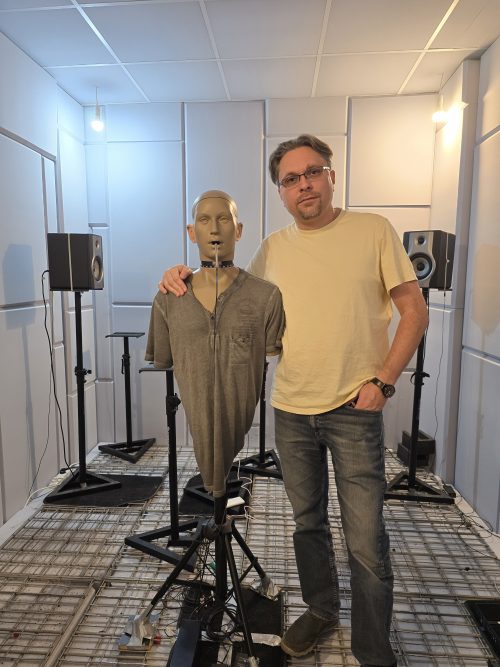
I’m thrilled to share that MMN Magazine recently interviewed me about www.AudioTag.info, its underlying acoustic fingerprinting technology, my other audio technologies including watermarking solutions available at www.AudioWatermarking.com and some more.
A big thank you to my friends at MMN Magazine and to Peter Bokor personally for this wonderful opportunity. You can check out the full interview here: https://mmn-mag.hu/2024/06/03/audiotag-challanging-shazams-fingerprinting
Stand with Israel!

Слава Україні!

Things that should not exist
Manual gear in cars
Cooling fans in computers
Man tie
Tennis